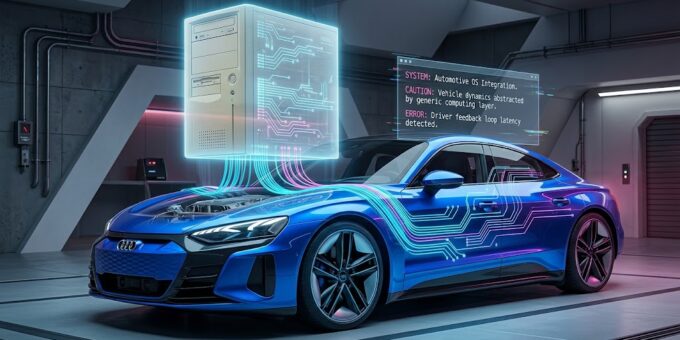
I recently had a fascinating exchange on LinkedIn with an investor and researcher, whom we’ll call “R” who has been following the meteoric rise of the “Software-Defined Vehicle” (SDV) and noticed the massive deals happening between ride-hailing giants like Uber and various carmakers.
R’s question was one that hits the very core of the automotive identity crisis: Will hardware eventually become a generic “computing box,” or will this shift force engineers into an era of specialized chip design we’ve never seen before?
R: “Now that everyone is shifting toward this software defined direction, do you think this will cause automotive hardware to gradually become a more generic ‘computing box’?”— From a recent LinkedIn thread
In my 18 years of blogging here at The Technic Alley, I’ve found that when people ask about “generic” hardware, they are often looking at the system through a lens of commoditization. But as an engineer, I see a different pattern: The Path of Absorption.
The Historical Loop: Integration is Not De-valuation
In the early days of any electronic system, we build with what’s on the shelf—standard logic chips on a PCB. It’s bulky and inefficient, but it works for prototyping. As the “System” matures, that complexity is swallowed by programmable logic (FPGAs). Eventually, when the volume is high enough and the power/performance requirements are strict enough, we bake it into an Application Specific Integrated Circuit (ASIC).
When “R” asks if hardware is becoming a “generic box,” my answer is rooted in this history: Hardware doesn’t become generic; it becomes invisible. By the time a processor appears “generic” in the industry, it simply means we have finally perfected the hardware-software handshake for that specific domain. But the frontier of innovation always moves to custom silicon to find the next 10% of efficiency.
“Software might be the soul of the modern car, but the silicon is its nervous system—and generic nerves can only react so fast.”
The Cognitive Trap: Functional Fixedness
Why are we so quick to assume the hardware is just a vessel? I believe we are suffering from Functional Fixedness. Because we see a car performing “computer tasks”—running apps, navigating with AI, updating over the air—we mentally categorize it as a “Computer.”
We assume that because a laptop is a “generic box,” a car must be one too. But a car is a safety-critical, high-power, thermal-management nightmare. A PC doesn’t have to manage an 800V battery architecture while performing millisecond-latency emergency braking. When you ignore the physical system, you fall into the Simplification Bias—assuming the code is the only thing doing the work.
The Two-Track Future
I suspect the automotive market will split into two distinct tracks:
- Track 1: The Commodity Fleet. These are the “Robotaxis” for Uber. Here, the goal is the lowest cost-per-mile. Standardized, generic computing hardware makes sense here because the “product” is the ride, not the vehicle.
- Track 2: The Vertical Integrators. These are the “Apples” of the car world (Tesla, Rivian, Lucid). For them, generic hardware is a bottleneck. To create a unique feature—like advanced regenerative braking or superior AI response—they must build the hardware and software vertically.
In the end, “Software-Defined” doesn’t mean hardware doesn’t matter. It means the hardware must be so good, so integrated, and so specialized that the software is finally free to do its job without friction.