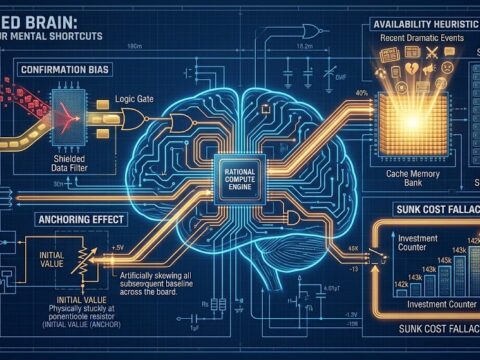
TL;DR: Hardware engineering and behavioral psychology are two sides of the same discipline: modeling complex, resource-constrained systems under noisy conditions. Cognitive biases are not random human flaws—they are evolutionary heuristics running like unpatched legacy firmware in modern environments. Just as we design ASICs to tolerate parasitic capacitance, clock jitter, and process variation rather than ideal conditions, we must design technical systems, architectures, and team processes around the real constraints and failure modes of human operators.
A casual reader scanning the archives of The Technic Alley might suspect an editorial identity crisis.
On one track, you will find deep dives into physical hardware: System-on-Chip (SoC) floorplanning, timing closure, digital logic constraints, and embedded fault diagnostics. On the other track, you will find analyses of behavioral economics, cognitive biases, mental models, and decision-making traps.
To a casual observer, these fields sit on opposite sides of a canyon. Hardware engineering is deterministic, grounded in Maxwell’s equations, boolean algebra, and picosecond clock domains. Psychology is notoriously messy, dealing with irrational decisions, heuristics, and subjective emotional states.
In practice, an engineer working across both disciplines discovers they are not different subjects at all. Both study the exact same problem: how complex, resource-constrained architectures process noisy inputs under finite bandwidth and energy limits.
1. Heuristics as Hardcoded Legacy Firmware
When silicon real estate and power budgets are tight, chip designers don’t implement full, high-precision floating-point logic for every operation. Instead, we compromise: we use lookup tables, interpolation, bit-shifts, or truncated polynomial approximations. We intentionally trade mathematical precision for low latency and minimal gate count.
Human cognition evolved under identical constraints. In ancestral environments, running a deliberate, high-energy analytical calculation when hearing a rustle in the grass carried an unacceptable latency cost. Survival selected for fast, low-power heuristics: rapid pattern matching, threat amplification, and loss aversion.
The trouble begins when those heuristics run inside modern operating environments. When an engineer evaluates statistical telemetry, prices market risk, or debugs an unfamiliar failure mode, those primitive shortcuts fail systematically. What a psychologist labels a cognitive bias (such as confirmation bias or the availability heuristic) is precisely what a verification engineer would identify as an unhandled edge case in legacy firmware.
Studying behavioral science is not an academic exercise in cataloging human quirks; it is a rigorous root-cause analysis of how biological processors malfunction when operating outside their original design specifications.
2. Coupled Dynamics and Parasitic Feedback
Neither a multi-core processor nor an engineering organization operates as a collection of decoupled, isolated blocks. Both are defined by closed-loop interactions.
In modern SoC design, optimizing a single block in a silo is a recipe for system failure. Shaving picoseconds off one critical path can generate localized thermal hot spots, induce supply-rail droop, or starve an adjacent bus. The engineer’s job is rarely just optimizing a component; it is modeling parasitic effects, impedance matching, and closed-loop stability across the whole substrate.
Behavioral systems exhibit identical coupled dynamics. Individual incentives, cognitive bandwidth limits, and organizational incentives interact to generate counter-intuitive macro outcomes. For example, introducing a rigid, mandatory bug-logging rule often incentivizes engineers to break issues into trivial micro-tickets to hit velocity metrics, completely obscuring systemic architectural flaws.
Whether tracking parasitic inductance across a power grid or diagnosing institutional inertia, the fundamental skill remains unchanged: look past surface telemetry, isolate the feedback loops, and identify where the impedance is actually accumulating.
3. Designing for Real Margins, Not Idealized Models
Classical economics long relied on the fiction of Homo economicus—the perfectly rational agent operating with complete information and infinite compute capacity.
In hardware design, anyone who designs for ideal components is weeded out quickly. Real wires have parasitic resistance and capacitance; real silicon suffers from process-voltage-temperature (PVT) variation; real power supplies ripple under transient loads. If a design only functions under nominal, room-temperature, noise-free conditions, it is a liability, not an engineering deliverable. We budget for worst-case corners, jitter, and signal-to-noise degradations.
Applying behavioral psychology to technical workflows means engineering for actual human operating margins:
- Fatigue Degradation: Operators under stress suffer from attentional tunneling, ignoring peripheral alerts.
- Interface Ambiguity: Ambiguous tooling and dense configuration syntax inevitably trigger operator error during high-stress recovery windows.
- Cognitive Saturation: Overloading a triage dashboard with hundreds of alerts leads directly to alarm fatigue and missed catastrophic signals.
Building robust automation, safety interlocks, and readable register maps requires anticipating human cognitive limits just as deliberately as a designer provisions setup and hold time.
4. The Social Architecture of System Failures
Post-mortems frequently reveal that major technical disasters rarely occur because the underlying physics failed. They occur because the human review and decision pipeline failed.
Engineering teams consistently encounter predictable organizational bugs:
- The Planning Fallacy: Treating the best-case execution schedule as the nominal path, chronically under-budgeting integration and verification overhead.
- The Sunk-Cost Fallacy: Pouring capital and engineering cycles into a flawed architectural approach simply because a team has already spent a year taped to that methodology.
- Groupthink and Authority Bias: Suppressing dissenting bench data during critical design reviews to preserve consensus or defer to hierarchy.
Understanding behavioral traps turns post-mortems from finger-pointing exercises into architectural refactoring. It allows technical leadership to debug the review process itself—structuring blind reviews, incentivizing red-team dissent, and insulating raw telemetry from political pressure.
Closing the Loop
Silicon and biological wetware run on radically different physical substrates, but they share the same fundamental engineering trade-offs: latency versus power, throughput versus accuracy, and local optimization versus global stability.
Studying behavioral psychology does not pull an engineer away from technical rigor. It simply applies that rigor to the most unpredictable, high-impact, and safety-critical component in the entire system: the human being at the console.