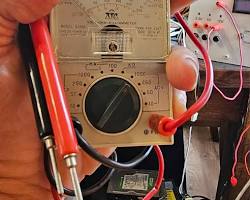
The Symptom: The “Half-Dead” Kitchen
It started with a common household annoyance: the garbage disposal went silent, but the dishwasher was functional. But as any engineer knows, the “simple” failure is often a liar. When I put a multimeter to the outlet, I didn’t find 0V (a tripped breaker) or 120V (a working circuit).
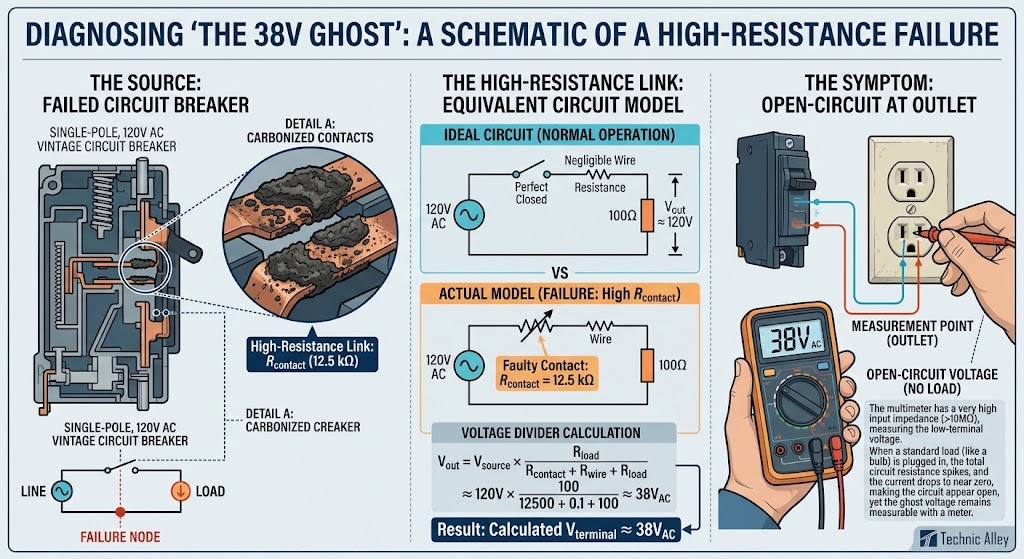
I found 38 Volts. In the world of AC power, 38V is “phantom” territory. It’s enough to glow a status LED on a high-end appliance, but not enough to provide the torque for a motor. It’s the calling card of a high-resistance connection.
The Mystery: The MWBC Architecture
As I dug into the kitchen wiring, the plot thickened. I discovered the kitchen was wired using a Multi-Wire Branch Circuit (MWBC). For the uninitiated, an MWBC uses two “hot” wires (on opposite phases) sharing a single neutral.
The Engineering Challenge: 1. Phase Alignment: If the two hots are on the same phase, the current on the neutral doubles (fire hazard). They must be on opposite phases (Phase P and Phase Q) so the return currents cancel each other out.
2. The “Ghost” Connection: Why was the disposal leg showing 38V while the dishwasher leg on the same cable was at a solid 120V?
The Hunt: Crouse-Hinds Archaeology
My home uses an older Crouse-Hinds panel—a brand that has since been absorbed and made obsolete. These panels use 1/2-inch “twin” or “tandem” busbar stabs. Finding a modern replacement that safely bridges two different phases while maintaining the narrow 1/2-inch footprint is a hunt for a unicorn.
After some research into the busbar geometry (and confirming that phases alternate every 1-inch vertically), I sourced a Quadplex breaker. This unit occupies two 1-inch slots, grabbing both Phase P and Phase Q, while providing four independent 20A circuits in a compact housing.
The “A-ha!” Moment: Carbonization
When I finally killed the main breaker and pulled the old units, the culprit was staring me in the face. The internal “jaw” of the breaker and the metal busbar “stab” were carbonized.
Over decades of high-surge loads (think air fryers and garbage disposals), a tiny bit of arcing had created a layer of carbon soot. Carbon is a semiconductor; it was acting as a high-value resistor.
- The Math: $V = I \times R$. The carbon was “eating” 82V of my 120V potential, converting it into heat right inside my panel.
- The Fix: I filed the busbar stab down to bright, shiny metal and installed the new Quadplex.
The Final Configuration
To make the system “Technic Alley Approved,” I customized the new breaker:
- The Center Pair (B+C): These feed the MWBC. I kept the handle tie intact to ensure a “common disconnect,” as per modern safety code for shared neutrals.
- The Outer Pair (A+D): These feed the fridge and lights. I removed the external metal U-clip handles to allow them to trip independently—ensuring a disposal jam doesn’t spoil the milk.
Engineering Lessons Learned:
- Check the Stab: If you replace a breaker and don’t clean the busbar, your new breaker will fail in months. The carbon is the disease; the dead breaker was just a symptom.
- Torque Matters: Motors (GD) and heaters (Air Fryers) are the “torture tests” of electrical connections.
- Ghost Voltages are Real: When a multimeter shows you 30-90V, stop looking for a “trip” and start looking for “resistance.”
Toolkit Addition: This project convinced me to add a Klein RT390 Circuit Analyzer to my kit. It performs a “Load Test” to identify voltage drops before they turn into carbonized busbars.
Stay tuned to the /ee section for a full house-wide electrical health audit.