When my vet flagged a potential issue during a routine checkup for my healthy six-year-old mini-poodle, I was perplexed. The diagnosis wasn’t a disease, but a systemic insufficiency: she wasn’t drinking enough water.
The vet suggested logical, short-term workarounds—adding water to her meals or switching to high-moisture food—but my engineering mindset needed to understand why a healthy animal with constant access to water was failing to self-regulate its critical hydration loop.
The solution, it turned out, required diagnosing an ancestral canine subroutine and deploying a technical hardware patch.
I. The Diagnostic: Ancestral Systems vs. The Stagnant Bowl
My research led to a surprising conclusion: the traditional water bowl is a “perfect storm” of suboptimal design for an animal that evolved in the wild.
In nature, animals treat stagnant water (ponds, puddles) as a potential biological hazard. Stagnant water carries a high systemic risk: it accumulates bacteria, collects toxins, and incubates deadly parasites. Flowing water (streams, rivers) generally registers as a lower-risk, oxygenated, and safer source.
Canines have inherited a powerful Evolutionary Caution Protocol (inherited from wolves). When they encounter a stagnant source, their biological need for water fights against this cautious subroutine. The result is a suboptimal system where the dog drinks just enough to clear the thirst threshold, rather than drinking optimally.
Evidence of the “Caution Flag”
I looked back at my own setup. I had water in two standard, stationary bowls. My dogs primarily used them only after a major system event—a long walk, a meal, or a period in the sun. At other times, they largely ignored them.
I also validated this caution subroutine with a key observation: whenever I performed a daily “System Flush”—washing the bowl and adding fresh water—the dogs would immediately visit the bowl and drink. The fresh, movement-filled input was temporarily bypassing the “Caution” flag.
I wasn’t managing a dog that wasn’t thirsty; I was managing a system with a flawed input source.
II. The Solution: Implementing the Flowing Water Patch
I began analyzing potential system hardening solutions. The market offers several “Recirculating Fountain” units. Some flow constantly, while others are motion-activated. My requirement stack included:
- Small-Dog Portability: Must be easy to move to different logical zones in the house.
- Built-in Filtration: System logic requires continuous contaminant removal.
- Untethered Operation: No power cords (for safety and placement flexibility).
- Long-Life Rechargeable Battery: 1–2 weeks per cycle is ideal.
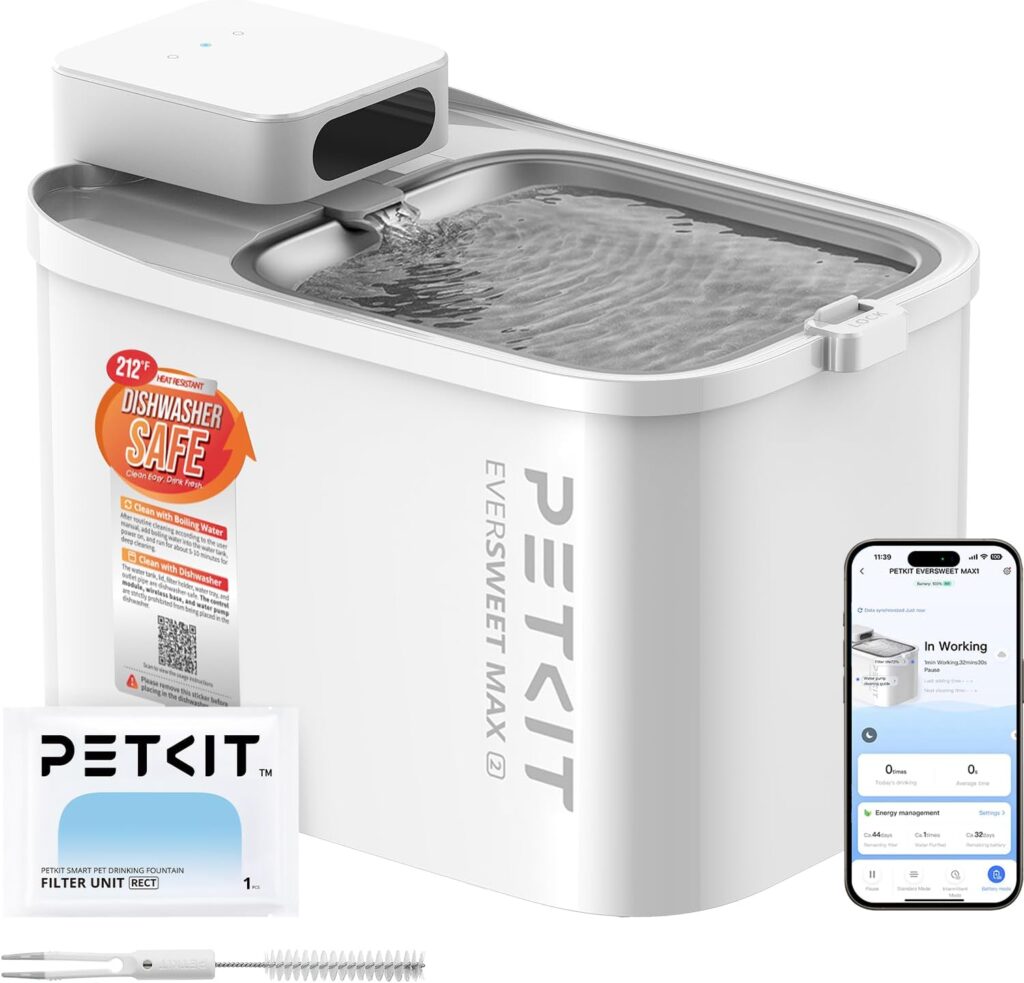
I selected the PETKIT Dishwasher Safe Cat Water Fountain. It hit every requirement, including app control and a large 101 oz (3L) reservoir.
Technical Specifications of the PETKIT Unit
| Component | Technical Function | Systemic Patch |
| Recirculating Pump | Induces Differential Turbulence | The moving water and ripples visually signal freshness, directly activating the animal’s “Flowing = Safe” subroutine and bypassing the “Caution” flag. |
| Integrated Multi-Stage Filter | Executes Trace Contaminant Removal | Actively filters out hair, bacteria, and debris while removing chlorine (which can overload sensitive canine olfactory sensors). This keeps the water appealing long-term. |
| Motion Sensor | Deploys a Demand-Input Logic | The flow activates only when the dog approaches, conserving battery and creating a unique behavioral cue. |
| App Monitoring | Provides Real-Time Data Access | I can track their hydration stats (in mL), receive maintenance alerts, and even remotely update the pump behavior (e.g., constant vs. interval flow). |
III. System Validation and Post-Mortem
The Transition Phase
Because my dogs had used a stationary bowl for years, I didn’t want to cause a major system shock by removing their known source immediately. I deployed the fountain using a Reverse Dependency Protocol:
- Day 1-3: I kept the old standard bowl in the primary position (in front) and placed the new fountain (the gadget) behind it.
- Result: As the water level in the bowl naturally dropped over the next few days, the dogs noticed the new moving source. They began drinking from it and seemed genuinely pleased by the active flow. I successfully confirmed my six-year-old was now drinking more water.
Final System Architecture
My hydration system is now optimized and resilient. The fountain is in the primary position, with the traditional bowl as a reliable back-up unit in case the fountain runs dry or requires a recharge cycle.
The maintenance loop is efficient:
- Refill: I add fresh water every 3-4 days.
- Cleaning: The unit is highly modular. The electronics detach easily for recharging (1–2 hours), while the remaining structural components are dishwasher-safe.
- The “Backup Validation”: I rarely see them use the back-up bowl. When they do, I take it as a diagnostic signal that the fountain water may be getting stale and requires a full refresh—validating that they are self-regulating their preference for flow.
By recognizing the underlying biological feedback system (Evolutionary Caution) and deploying the Recirculating Fountain technical patch, I have successfully hardened my dog’s hydration infrastructure for optimal, long-term performance.
