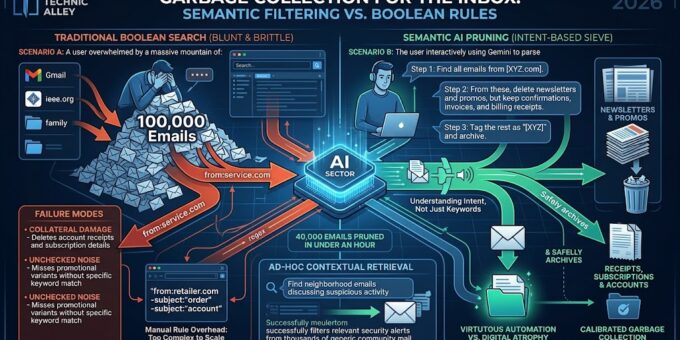
TL;DR: Over 20 years, an aggregated Gmail inbox naturally accumulates staggering levels of digital debt—in my case, nearly 100,000 unread messages, newsletters, and promotional alerts. Traditional boolean search strings scale poorly when trying to separate promotional noise from vital account receipts. By leveraging Gemini in Gmail for multi-step semantic filtering, I pruned 40,000 emails in under an hour without writing rigid regex or risking accidental loss of critical records. Here is the framework for applying intelligent garbage collection to decades of digital detritus.
I have been using Gmail for over twenty years. Over that time, my primary inbox quietly evolved into a central aggregation hub. It receives forwarded mail from an IEEE account, a secondary professional mentoring address, a shared family account, and an alias dedicated to blog infrastructure management.
When an inbox runs continuously for two decades across multiple domains, subscription creep is inevitable.
Sign up for a utility, buy tires, file taxes online, adopt a pet, or register for an industry whitepaper, and you are quietly opted into ongoing dispatches. Over years, newsletters from publications, Substack digests, LinkedIn notifications, financial updates, and endless promotional cycles from Costco, auto shops, and retail services compound.
I regularly triaged my inbox for high-priority items, but the collateral noise remained unread. Unchecked, that background accumulation pushed my mailbox toward a daunting milestone: nearly 100,000 emails.
The Failure of Traditional Boolean Search at Scale
In the past, whenever the inbox hit a couple thousand unread messages, standard systems hygiene worked:
- Construct a targeted search string (
from:service.com). - Visually scan the results.
- Apply appropriate tags, archive what mattered, and mass-delete the rest.
At 2,000 emails, manual rule-making and regex-style boolean queries are viable. At 100,000 emails, the sheer volume turns manual sorting into a multi-day slog.
The biggest bottleneck isn’t deleting messages—it is avoiding collateral damage.
If you use a blunt filter like from:retailer.com and hit Delete All, you purge marketing blasts, but you also destroy order confirmations, password reset records, and warranty receipts. Traditional keyword filters lack context. They force you to spend hours writing convoluted exclusion strings (from:retailer.com -subject:"receipt" -subject:"order" -subject:"account") that still risk false positives and false negatives.
Faced with a 40-hour manual cleanup project, inertia wins. The debt simply continues to compound.
Semantic Filtering: The Multi-Step Prune
This is where integrating Gemini directly into Gmail fundamentally altered the maintenance dynamic. Instead of relying on brittle keyword syntax, conversational AI allows for semantic, context-aware filtering.
By executing a sequence of simple natural-language prompts, I tackled the backlog sender by sender, pruning nearly 40,000 emails in less than an hour.
The workflow followed a predictable three-step pipeline:
Step 1: Scope the Domain
Instead of building complex search operators, start by isolating the vendor or sender cluster:
“Find all emails from [Service/Domain Name].”
Step 2: Apply the Semantic Sieve
This is where standard search falls apart and semantic analysis shines. Instead of crafting exclusion keywords, instruct the model on intent:
“From these, delete all newsletters and promotional emails, but keep order confirmations, account subscription details, and billing receipts.”
The model evaluates the context of the email rather than matching static text. Promotional announcements disappear, while critical account milestones remain intact in the buffer.
Step 3: Classify and Archive
With the noise eliminated, structuring the remaining valuable records takes a single command:
“Tag the remaining emails as ‘[Label Name]’ and archive them.”
What previously required clicking through hundreds of pagination screens, squinting at subject lines, and dreading an accidental deletion became a sixty-second background task per domain.
Ad-Hoc Contextual Retrieval
Beyond batch pruning, semantic querying proved equally valuable for situational awareness across massive email archives.
In large community or neighborhood distribution lists, volume often obscures critical signal. Running a prompt like:
“Find all emails in my neighborhood group discussing suspicious activity over the last six months.”
Rather than surfacing every email containing the keyword “suspicious” (including lost dog notices and software alerts), the query extracted actual discussions of neighborhood security incidents. It allowed me to review missed context and determine if any follow-up queries required an answer—without spending an evening digging through archive folders.
Automating the Toil, Keeping the Judgment
In engineering, we frequently emphasize the danger of abdicating foundational thinking to AI. But routine garbage collection is not foundational thinking.
Spending hours writing repetitive search queries to parse junk mail from dry cleaners and retail accounts is low-value operational drag. Offloading that toil to an intelligent query engine frees up cognitive bandwidth for tasks that actually require human design, analysis, and strategic focus.
If your inbox has accumulated years of digital debt, don’t write complex boolean rules. Treat your cleanup like an architectural refactor: define your intent, let semantic models filter the noise, and preserve what matters.