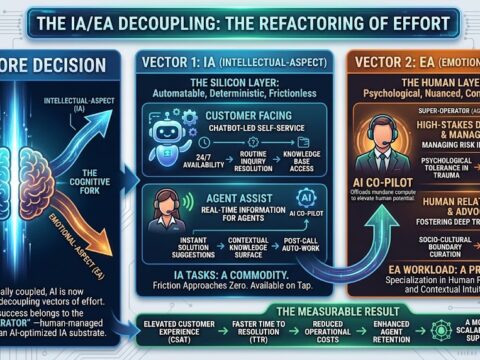
TL;DR: AI is not replacing human effort uniformly; it is splitting it into two distinct vectors. The Intellectual-Aspect (IA)—logic, data, and routine problem-solving—is rapidly becoming a cheap, automated commodity. The Emotional-Aspect (EA)—psychology, resilience, context, and human connection—is becoming our most valuable premium. The future belongs to the “Super-Operator”: professionals who completely offload their IA compute to machines so they can specialize entirely in the high-stakes, nuanced EA work that algorithms cannot safely emulate.
If you analyze the integration of Artificial Intelligence purely through the lens of compute power, you miss the actual socio-cultural fault lines. AI does not disrupt industries uniformly; it disrupts specific vectors of effort.
To map out how this technology will actually alter our daily lives, we need to split human effort into two distinct operational vectors:
- The Intellectual-Aspect (IA): The deterministic layer. This is how we process logic, aggregate data, recognize patterns, and execute constrained problem-solving.
- The Emotional-Aspect (EA): The psychological layer. This is how we navigate ambiguity, manage human resilience, foster trust, and understand subjective, contextual nuances.
Historically, humans have been required to process both vectors simultaneously. AI is now aggressively decoupling them, vaporizing the IA workload while exposing the sheer difficulty of the EA workload.
By running this IA/EA framework across the primary sectors of human life, a clear pattern emerges: the future does not belong to the generalist. It belongs to the Super-Operator—the human who completely offloads the IA compute to machines, and specializes entirely in high-level EA management.
Here is the diagnostic breakdown of the transition.
1. The Human Processor: Child Development, Education, and Coaching
Nowhere is the IA/EA split more critical—and potentially dangerous—than in how we program the next generation of human processors.
The IA Impact: For transmitting simple concepts, digital aids will largely replace human instructors. Whether learning a new language, mastering a math theorem, or analyzing an athletic swing, AI will provide infinite patience, personalized pacing, and instant feedback.
The EA Constraint: Human cognition, however, is heavily dependent on biological bonding. Learning hard concepts requires emotional resilience. A human teacher or coach doesn’t just deliver data; they manage the student’s frustration, provide a new perspective during a slump, and anchor the knowledge deeply through shared human experience. Without this EA reinforcement, knowledge gained from an AI agent can be superficial, fading quickly when the app is closed.
The Vulnerability: As Jonathan Haidt explores in The Anxious Generation, social media has already severely disrupted the fundamental biological dependency loop between children and caregivers. AI threatens to accelerate this, creating a false illusion of independence at a dangerously early age, fundamentally altering human socio-cultural development.
The Outlook: We will see the rise of the Super-Teacher and Super-Coach. We will need fewer overall instructors to deliver baseline data, but we will desperately need elite EA-specialists to guide students through paradigm shifts, PhD-level ambiguities, and the emotional mechanics of elite performance.
2. High-Stakes Diagnostics: Healthcare and Emergency Services
In fields where the cost of failure is catastrophic, the transition will redefine the meaning of expertise.
The IA Impact: AI is exceptionally suited for high-volume pattern recognition. Analyzing blood work, urinalysis, EKGs, and X-rays will become almost entirely automated. AI will rapidly filter telemetry, flag anomalies, and suggest optimal triage routing for emergency services. It will save massive amounts of time, allowing patients to track their own metrics and explore baseline treatments independently.
The EA Constraint: Medicine is not just data-matching; it is risk management in the grey areas. When an AI narrows down a diagnosis, the human operator must contextualize it against the patient’s unstated emotional state. Dealing with the psychological toll of a chronic illness, guiding a family through a crisis, or navigating the nuanced risks of an unprecedented trauma requires a human touch that an automated system cannot safely emulate. Over-reliance on AI in mental health or emergency triage without an EA safety-net invites disaster.
The Outlook: The medical field will consolidate around the Super-Doctor. Routine diagnostics will be pushed to the AI substrate, leaving human physicians to operate exclusively as high-level risk managers and emotional navigators for complex, critical cases.
3. Synthesis and the Built Environment: Engineering, Architecture, and Content
The domains of creation—whether writing code, drafting a floorplan, or publishing a blog—are experiencing a massive drop in execution latency.
The IA Impact: The friction of generation is approaching zero. In physical engineering (mechanical, EE, CS), AI will solve constrained design problems, route traces, and analyze data exponentially faster. In architecture, a user can iterate through hundreds of interior design variations in seconds based on a simple text prompt. In content creation, algorithms can scan datasets, handle SEO, and draft coherent reports, blogs, and even books instantly.
The EA Constraint: Output without EA context feels “manufactured.” AI-generated architecture often lacks the subtle, emotionally soothing human elements or ethnic/community aesthetic considerations that make a space feel alive. In literature and journalism, heavy reliance on AI dilutes the intimacy of the communication; books begin to read like technical manuals, and personal correspondence loses its psychological weight. In engineering, while AI can optimize a known paradigm, it requires human creativity to invent an entirely new one.
The Outlook: The barrier to entry for producing content and designs has vanished, but the premium on authenticity has skyrocketed. Expertise will migrate from writing syntax to curating the socio-cultural boundaries of the technology.
4. The Operating System of Daily Life: Logistics, Travel, and the Home
This is the sector where the IA/EA friction is lowest, and the benefits of AI are most universally welcomed.
The IA Impact: AI will act as a frictionless personal logistics engine. Autonomous transport networks will eliminate the stress of ownership, maintenance, and parking. Last-mile drones and robotic carts will make delivery deterministic. Complex travel planning—synthesizing weather, family preferences, bookings, and contingency plans—will take seconds. In the kitchen, AI will instantly adapt recipes based on available pantry items and dietary constraints.
The EA Constraint: The losses here are subtle but deeply human. While autonomous logistics remove the stress of “how to get there,” over-reliance on a personal AI scheduler can induce the claustrophobic feeling of being managed by an algorithm. In the culinary world, while the AI can perfectly substitute baking powder for yeast in a pinch, the cultural punch of something made “just like mom makes” will lose its distinctiveness in a sea of perfectly optimized, algorithmic meals.
The Outlook: As digital friction drops to zero, deliberate friction will become a premium. We will see the rise of “Analog Luxuries”—where people actively pay to do things the hard, un-optimized, human way just to preserve the EA satisfaction of the experience.
The Verdict
The AI transition is not a simple substitution of labor; it is a fundamental refactoring of human value.
We are moving into an era where Intellectual-Aspect (IA) tasks are a commodity, available on tap like electricity. The individuals and systems that will thrive are those that recognize this shift immediately, allowing the AI to handle the mundane compute cycles while they fiercely protect, develop, and deploy their Emotional-Aspect (EA) bandwidth.