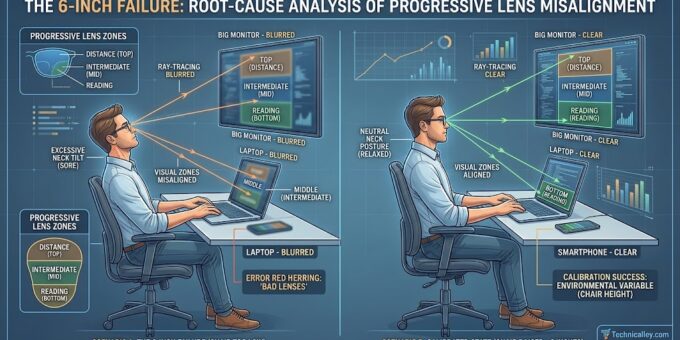
TL;DR: When a sudden onset of blurry vision and neck pain hit me at my desk, my immediate assumption was a hardware failure: my three-year-old progressive lenses or my actual eyesight. After swapping glasses yielded no real improvement, I stepped back to evaluate the broader system. The culprit wasn’t optical degradation—my office chair had mysteriously dropped six inches, completely throwing off the focal angles required for progressive lenses. Always check your environmental variables before you blame the core hardware.
My progressive lenses have worked flawlessly for three years. So, when I suddenly started noticing severe blurring at my desk about a week ago, it felt like a classic system failure.
The symptoms were localized but highly disruptive. My desk setup consists of a laptop on the desk and a larger monitor mounted slightly behind and above it. Suddenly, the laptop screen was a bit blurred, forcing me to raise my head to read clearly. The big monitor was even worse; I had to tilt my head uncomfortably high to find the “reading” area of my lenses, leading to noticeable stiffness in my neck.
Yet, isolated subsystems were working fine. The smartphone in my hand was easy to read. Sitting on the couch at home with the laptop on my lap was perfectly clear.
My immediate engineering instinct was to suspect the most critical and complex component: my eyes, or the lenses themselves.
But the data didn’t quite make sense. Biological vision degradation is typically gradual. Why had this happened over just a few days? Had I hit some physiological tipping point? I wondered if the glasses were sitting too low on my nose, or if the nose pads had accidentally been bent. To test the hardware hypothesis, I switched to a generic backup pair of progressive glasses. The improvement was slight—nowhere near the resolution I expected.
The hardware wasn’t failing. The calibration was off.
I stopped looking at the lenses and started looking at the environment. I noticed my office chair was sitting at its absolute lowest position. Because of this, my laptop screen was almost perfectly level with my eyes, and the large monitor was towering above my head level. I was forced to look upwards just to center my eyes on the screen, and tilt my head back even further to utilize the lower reading portion of the progressives.
I had a gap between my legs and the keyboard drawer, so I raised the chair by about six inches. My feet were still comfortably on the floor, and I could slide the keyboard tray in and out easily.
The geometric shift was instant. The laptop dropped well below my eye level, falling perfectly into the reading zone of my lenses. The big monitor was now almost level with my eyes, requiring zero neck tilt to view clearly. Everything snapped back into crystal-clear focus.
For some reason—maybe I lowered it to speak to a coworker, maybe someone borrowed it and adjusted the height, or maybe it was swapped entirely—my chair had dropped. That six-inch change in my Z-axis had completely misaligned my optical sensors with the workstation.
It is a classic troubleshooting trap: when faced with a sudden failure, we often rush to diagnose the most complex, expensive part of the system rather than checking the basic environmental variables.
For progressive lens wearers, the optimal workstation geometry isn’t just about ergonomics; it’s a hard optical requirement:
- Laptop: Placed on the desk, distinctly below eye level.
- Primary/Large Monitor: At eye level or only slightly higher.
- Chair: High enough to accommodate this downward viewing angle without the keyboard drawer rubbing against your legs, keeping your feet firmly grounded.