TL;DR: A recent debate with former engineering colleagues crystallized where we actually stand with AI and employment. AI will not eliminate every human job, nor is ignoring it an option. Instead, we are entering an era of sharp organizational compression: a team of 4 AI-augmented engineers can now deliver the output of 10. Those 4 will enjoy their work more as tedious toil disappears, while 6 positions quietly vanish. Unlike past industrial revolutions that replaced human muscle and pushed workers up the cognitive ladder, agentic AI automates cognitive synthesis—and trains subordinate agents as it learns—creating a structural shift without a clear historical precedent.
Recently, a spirited debate broke out in a WhatsApp group of former engineering colleagues over a question dominating every industry: What is AI actually going to do to our jobs?
Most public commentary on this topic falls into one of two unhelpful extremes. On one side, techno-optimists insist that every wave of automation creates more jobs than it destroys, promising a golden age of abundance. On the other, doomsayers predict total human obsolescence within a few years.
When you strip away the hype and look at how engineering teams actually operate day to day, the reality is far more nuanced—and far more consequential. Stepping into the conversation, I laid out how I see the landscape right now:
- Will AI make us more productive? Yes, dramatically so.
- Will AI replace all human jobs? No.
- Do we need to embrace AI? Yes—because at this point, we have no competitive choice.
The real story isn’t about zero humans in the loop. It is about organizational compression.
The 4-vs-10 Team Dynamic
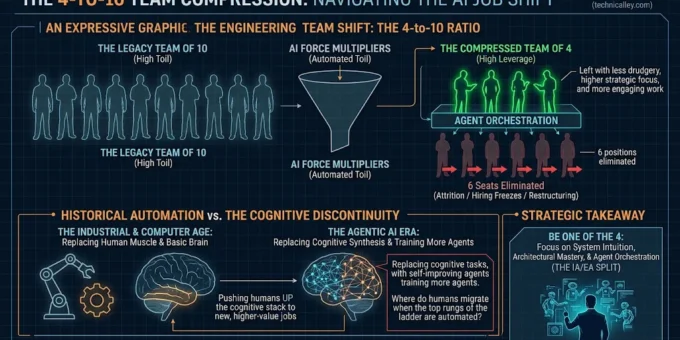
With modern AI tooling and agentic workflows, a focused team of 4 engineers can now accomplish the work of 10.
We are already seeing this math play out in practice. Tasks that used to consume a week of manual, error-prone grinding—such as executing hundreds of repetitive post-layout netlist edits or triaging massive backlogs of technical documentation—can now be staged, executed, and audited by a single senior engineer guiding an AI agent in an afternoon.
Look at what that 4-to-10 ratio means for the people inside an organization:
- The 4 who remain become force-multiplied architects. They spend far less time on mechanical drudgery, move faster from concept to verified implementation, and will likely enjoy their work significantly more than they did before.
- The other 6 positions, however, are eliminated—not necessarily through dramatic overnight layoffs, but through hiring freezes, unbackfilled attrition, and leaner project staffing.
The Unanswered Question of “New Jobs”
Whenever this compression math is raised, the standard counterargument from AI academia and industry pundits is historical precedent: Don’t worry, automation always creates entirely new categories of jobs we can’t imagine yet.
Perhaps it will. Yet when pressed to articulate what those new roles actually look like at scale, even the sharpest thinkers in AI research struggle to give concrete answers. Right now, “new jobs” is an article of faith rather than a visible roadmap.
More importantly, leaning blindly on historical analogies ignores a fundamental discontinuity in what is being automated.
Muscle vs. Self-Replicating Cognition
Throughout history, automation primarily replaced human muscle—and occasionally a narrow slice of routine arithmetic or clerical tracking. When steam engines, assembly lines, and early mainframes automated physical and repetitive labor, displaced workers could migrate upward into roles requiring judgment, coordination, and cognitive synthesis. There was always a higher rung on the ladder.
AI is fundamentally different: it is replacing large swaths of the human brain, and unlike a mechanical loom or a CNC machine, it can train and spawn additional agents as it learns.
When the automation substrate itself handles pattern recognition, code synthesis, verification scaffolding, and recursive self-improvement, the traditional upward migration path narrows dramatically. This is a genuinely new phenomenon in human history, and time will tell how our economic, social, and cultural structures adapt to absorb it.
Navigating the Shift
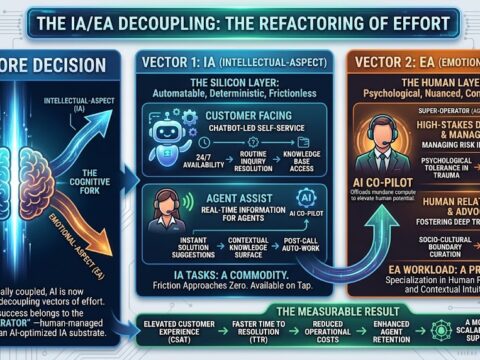
Earlier, when I first started mapping out how these capabilities intersect with our daily routines and professional workflows, I explored the boundary between internal judgment and external execution in The IA/EA Split: Mapping the AI Substrate Across Daily Life.
For working engineers and technical leaders, the strategic takeaway is straightforward. You cannot opt out of this transition, and you cannot afford to treat AI as a passing novelty. If teams are compressing from ten down to four, your primary career objective is ensuring you have the architectural mastery, system intuition, and agent-orchestration skills to be one of the four.