A marketing post recently made the rounds on LinkedIn from a hardware design automation startup, complete with the kind of headline guaranteed to trigger an ASIC engineer’s blood pressure:
“We built a working chip in 10 minutes that used to take 6 months.”
In the chip design trenches, an extraordinary claim like that demands immediate interrogation. I left a straightforward comment on the post:
“Does the 10 minutes include spec development, code generation, synthesis, and place-and-route?”
No reply from the founders. A few quiet likes from other hardware engineers who knew better, but complete radio silence from the poster.
A few days later, a nearly identical post appeared from an allied marketing account. I probed again, pressing on basic verification hygiene:
“What is the definition of a ‘working chip’ here? Is it synthesizable verified RTL, a gate-level netlist, a mask-ready database, or a packaged chip?”
Still no response. So I bypassed the marketing layer and read their technical documentation.
The website clarified the reality: their tool takes a structured specification prompt and outputs draft Verilog/SystemVerilog RTL in 10 minutes.
I updated my comment: “Your website says 10 minutes from spec update to RTL. Is that what you mean by a ‘working chip’ in this post?”
The author never responded, because answering honestly dissolves the illusion. Calling an unverified Verilog file a “working chip” is the hardware equivalent of handing someone a rough sketch of a fuselage on a napkin and claiming you built a working Boeing 787.
The Anatomy of Definitional Laundering
This is not harmless marketing enthusiasm; it is semantic laundering designed to exploit the knowledge gap between software compilation and physical semiconductor manufacturing.
To see why this claim collapses under basic engineering scrutiny, we have to look at what actually happens between a functional specification and a functional die:
[System Spec]
      │
      ▼
[RTL Generation]  <-- The startup's "10 minutes" stops here
      │
      ├── Functional Verification & Formal Proofs (UVM, Corner Cases)
      ├── Logic Synthesis (Mapping to Standard Cell Libraries)
      ├── Static Timing Analysis (STA & Multi-Corner Constraints)
      ├── Design for Test (DFT & Scan Insertion)
      ├── Physical Design (Floorplanning, P&R, Clock Tree Synthesis)
      ├── Physical Verification (DRC, LVS, Antenna, IR Drop Analysis)
      │
      ▼
[Tape-out: GDSII / OASIS Delivery]
      │
      ▼
[Wafer Fabrication] (Photolithography, Ion Implantation, Etch, CMP) ~ 12–16 Weeks
      │
      ▼
[Packaging & Post-Silicon Validation] (ATE, Bench Testing, Firmware Bring-Up)
      │
      ▼
[Actual "Working Chip"]
Generating RTL is roughly 5% to 10% of the front-end design cycle. Claiming that spitting out raw hardware description code constitutes a “working chip” completely discards the physical and logical realities of the medium.
The Bottleneck Fallacy
The fundamental flaw in the “10-minute” narrative is the assumption that writing RTL was ever the six-month bottleneck in hardware engineering. It wasn’t.
1. Verification Is the Real Work
Anyone with an afternoon and a reference manual can write a state machine in Verilog. The real discipline of digital design is proving that the state machine cannot deadlock, enter an illegal state, drop a handshake, or corrupt data when clock domains cross. Verification (UVM testbenches, assertions, coverage metrics, and formal equivalence) routinely consumes 60% to 70% of front-end engineering cycles. If you generate buggy RTL in 10 minutes, all you have done is accelerate the rate at which you generate verification debt.
2. Physical Design Obeys Maxwell, Not LLMs
Even if an automated tool produces logically sound, synthesizable RTL, that code has zero physical awareness. It knows nothing about:
- Wire congestion across metal layers.
- Clock skew across high-speed domains.
- Parasitic RC extraction and dynamic voltage drop ($IR$ drop).
- Thermal dissipation under maximum switching activity.
Timing closure is an iterative, constraint-heavy battle against physical parasitics. You cannot prompt your way past quantum tunneling or transmission line effects.
3. Silicon Cannot Be “Hotfixed”
In software, a 10-minute compile-and-deploy loop works because the cost of failure approaches zero: if a bug escapes to production, you push a patch. In ASIC design, a mask set at a leading-edge node costs millions of dollars, and a wafer cycle takes three to four months. A “working chip” is a designation reserved exclusively for packaged silicon that has survived automated test equipment (ATE) patterns, booted bare-metal code on a test bench, and proven functional stability across process, voltage, and temperature (PVT) corners.
Why Startups Push the Myth
Why risk the professional embarrassment of having experienced engineers publicly dismantle your product claims? The incentive architecture explains the behavior:
- The VC Valuation Loop: Software investors understand GitHub Copilot, rapid prototyping, and CI/CD pipelines. They rarely understand DRC violations or foundry shuttle schedules. Pitching an “AI that designs chips in 10 minutes” commands a massive valuation multiple; pitching an “RTL templating script for basic blocks” does not.
- The Denominator Trap: Just like viral social statistics that drop their sample size, hardware marketing routinely drops the qualifiers. “10 minutes from spec update to RTL draft” gets shortened by the agency to “10 minutes to RTL,” which gets handed to an ad manager who publishes “A working chip in 10 minutes.”
- The Open-Loop Audience: The founders ignore technical questions because LinkedIn is not a peer-reviewed journal. The goal of the post is not to convince a veteran lead designer; it is to generate impressions, algorithmic reach, and inbound investor inquiries from non-technical stakeholders who cannot tell a netlist from a packaged BGA.
Preserving Engineering Rigor
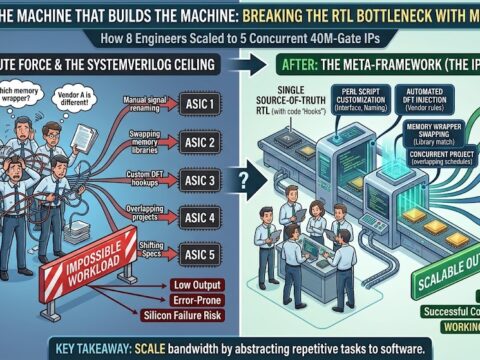
Automating RTL generation is a legitimate, worthwhile pursuit. Standard interfaces, repetitive control logic, and register banks should be automated so engineers can focus on architecture, performance per watt, and verification coverage.
However, when an EDA startup attempts to conflate text generation with hardware manufacturing, they do the entire industry a disservice. Writing code is not building a chip. Until your design has passed synthesis, closed timing across corners, cleared DRC/LVS, survived fab lithography, and powered up on a lab bench without smoking, you don’t have a working chip—you just have a text file.